• Welcome to your new Gnomio site

    Now, you are in control!

    Moodle is an open-source Learning Management System (LMS) that provides educators with the tools and features to create and manage online courses. It allows educators to organize course materials, create quizzes and assignments, host discussion forums, and track student progress. Moodle is highly flexible and can be customized to meet the specific needs of different institutions and learning environments.

    Moodle supports both synchronous and asynchronous learning environments, enabling educators to host live webinars, video conferences, and chat sessions, as well as providing a variety of tools that support self-paced learning, including videos, interactive quizzes, and discussion forums. The platform also integrates with other tools and systems, such as Google Apps and plagiarism detection software, to provide a seamless learning experience.

    Moodle is widely used in educational institutions, including universities, K-12 schools, and corporate training programs. It is well-suited to online and blended learning environments and distance education programs. Additionally, Moodle's accessibility features make it a popular choice for learners with disabilities, ensuring that courses are inclusive and accessible to all learners.

    The Moodle community is an active group of users, developers, and educators who contribute to the platform's development and improvement. The community provides support, resources, and documentation for users, as well as a forum for sharing ideas and best practices. Moodle releases regular updates and improvements, ensuring that the platform remains up-to-date with the latest technologies and best practices.

    Links of interest:

    (You can edit or remove this text)

Available courses

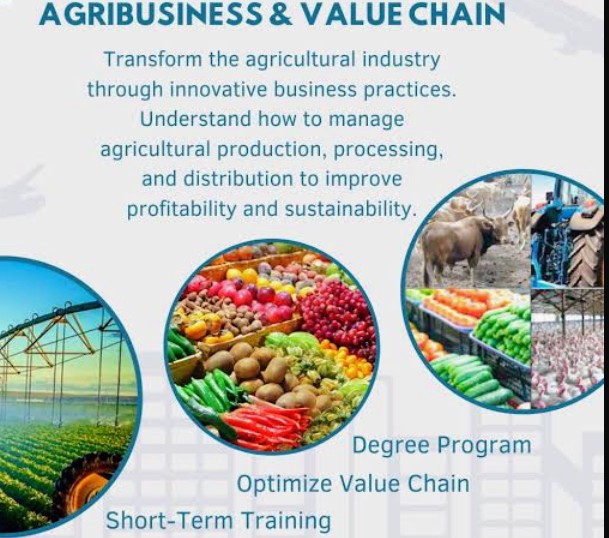
Screenshot_20260102-102948~3.pngScreenshot_20260102-102948~3.png

Course Overview: Introduction to Agribusiness Management

Agribusiness Management is an introductory course that focuses on the organization, operation, and management of agricultural enterprises within the wider agribusiness system. The course examines agriculture as a business and integrates principles of management, economics, and entrepreneurship as applied to the agricultural sector.

The course covers the agribusiness value chain, including input supply, farm production, processing, marketing, and distribution of agricultural products. Students are introduced to the roles of agribusiness firms, government institutions, cooperatives, and financial organizations in supporting agricultural development.

Key topics include:

Concepts and scope of agribusiness

Agribusiness systems and value chains

Principles of management (planning, organizing, staffing, directing, and controlling)

Farm and agribusiness entrepreneurship

Marketing of agricultural products

Agribusiness finance and credit

Risk and uncertainty in agribusiness

Role of technology and innovation in agribusiness

Agribusiness policies and the role of government

The course also emphasizes decision-making, problem-solving, and managerial skills required for efficient agribusiness operations. By the end of the course, students are expected to understand how agribusiness enterprises are managed, evaluate agribusiness opportunities, and apply management principles to improve productivity, profitability, and sustainability in the agricultural sector.

Meaning of Farm Management
Farm management is the application of economic principles to the organization and operation of a farm for maximum efficiency and profit.
2. Objectives of Farm Management
Maximize farm income
Efficient use of farm resources
Minimize production costs
Ensure sustainability of the farm business
3. Factors of Production in Farming
Land: Natural resources used in production
Labour: Human effort in farm activities
Capital: Tools, machinery, buildings, and money
Management: Decision-making and supervision
4. Functions of a Farm Manager
Planning farm activities
Organizing resources
Making production decisions
Keeping farm records
Controlling and evaluating farm performance
5. Farm Planning
Involves selecting farm enterprises and allocating resources to achieve farm objectives.